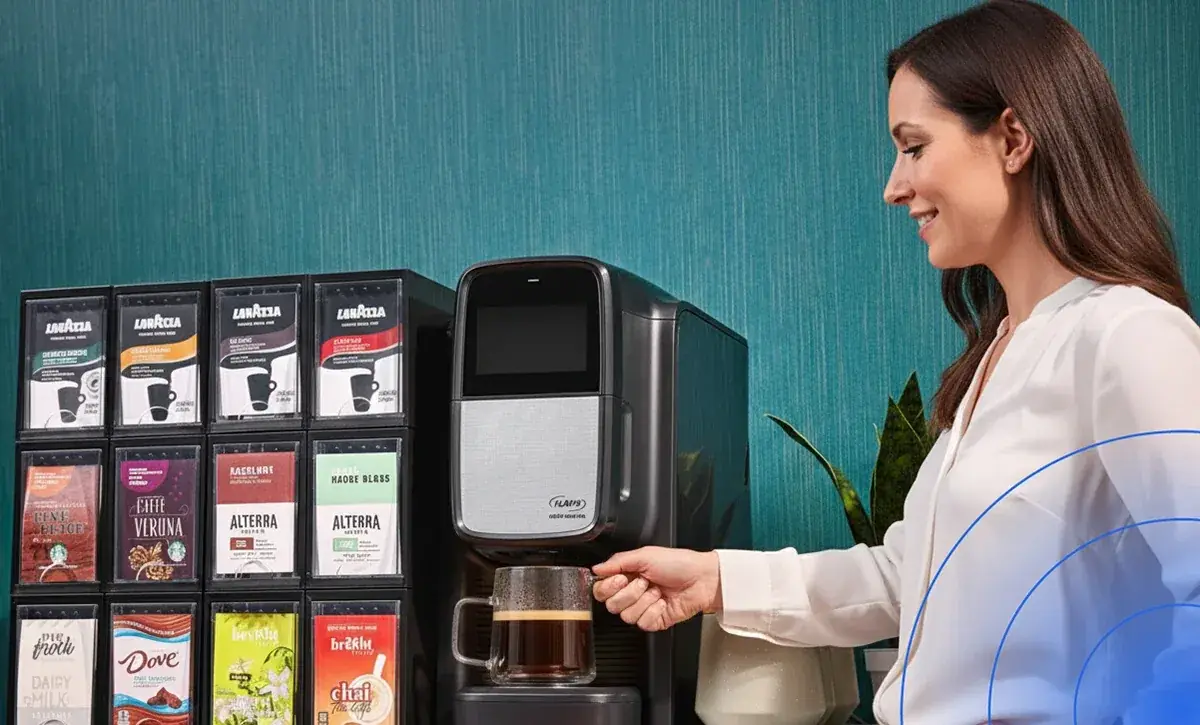
An office coffee service puts a commercial brewer, the coffee, and the supplies in your breakroom, then keeps everything stocked, cleaned, and repaired so nobody on staff has to. The real decision is which setup fits your team: bean-to-cup machines for café-style drinks, single-serve pods for variety in small offices, drip or airpot brewers for volume and shift changes, and cold brew as an add-on that earns its keep in an Atlanta summer.
This guide compares all four side by side, explains how to size coffee to your headcount, takes an honest look at pod waste, and lists what a full-service program should include before you sign anything.
What is an office coffee service?
An office coffee service is a provider that owns the coffee problem for you. Instead of someone buying a brewer, hauling cases of coffee from a warehouse club, and descaling the machine when it tastes off, the provider installs equipment sized to your space and handles the upkeep.
Programs range from a single brewer with regular supply drops to several stations across floors with espresso drinks, tea, and creamers. Many businesses run coffee alongside an office pantry program so snacks, drinks, and coffee supplies arrive on the same visit.
Why office coffee is worth getting right
Coffee is the one breakroom item almost everyone touches. The National Coffee Association's spring 2026 report found that 66% of American adults drank coffee in the past day, and 82% of those past-day drinkers had coffee prepared at home. That second number matters: your office coffee is competing with whatever your employees brew in their own kitchens.
The same research, as reported by Daily Coffee News, found the workplace was the most common place people drank coffee outside the home (14%), and that coffee drinkers averaged 2.8 cups a day. When one of those cups happens at work, a weak pot from a tired machine gets noticed every single day.
Timing matters too. NCA found 86% of past-day drinkers had coffee first thing in the morning and 22% had some in the afternoon. That tells you when your equipment will get hammered, and when a fresh pot or a cold option keeps people from leaving for a drive-thru. It is also why good coffee belongs on any list of return to office perks.
Bean-to-cup vs pods vs drip vs cold brew
Each format solves a different problem. Here is how they compare on the things office managers actually deal with.
| Setup | Best for | Cup quality | Morning rush | Upkeep | Waste |
|---|---|---|---|---|---|
| Bean-to-cup | Teams that want espresso, lattes, and fresh-ground coffee | Highest, ground per cup | Moderate, one drink at a time | Rinse cycles, regular cleaning and descaling | Low, grounds are compostable |
| Single-serve pods | Small teams that want variety and no mess | Consistent, depends on the pod | Slow once a line forms | Very low, empty the bin | Most packaging per cup |
| Drip or airpot | High volume, meetings, shift changes | Good when fresh, fades on a hot plate | Fast, one pot serves many | Brew, rinse carafes, toss filters | Low packaging, but dumped pots add up |
| Cold brew | Warm months and teams that already buy iced coffee | Smooth, low bitterness | Fast from a dispenser | Keep it cold, clean the dispenser | Low |
Bean-to-cup machines grind whole beans for each drink and make espresso, americanos, and milk drinks at the push of a button. They are a bigger piece of equipment and need disciplined cleaning, but they are the closest thing to a café on site. That matters as espresso keeps gaining ground: NCA put past-week espresso-based drinks at 45% of adults, up from 40% in 2022.
Single-serve pods are simple. Pick a flavor, press a button, and the cleanup is a used pod. They suit offices of roughly 25 people or fewer where variety beats volume. The tradeoffs are packaging waste and the line that forms at 8:45 when everyone wants a cup at once.
Drip and airpot brewers are the workhorses. A commercial brewer that fills insulated airpots keeps coffee hot without the burnt taste of a warming plate, which makes it the best fit for manufacturing floors, warehouses, and any site where a shift change sends a crowd to the breakroom at once. It is also familiar: in the NCA data, 37% of at-home drinkers used an automatic drip machine and 28% used a single-cup machine.
Cold brew rarely replaces hot coffee, but it makes a strong second option. A September 2026 summary of NCA's fall survey from NACS, the convenience retail trade association, reported that 21% of past-day coffee drinkers had cold coffee, up from 17% in January 2026. In metro Atlanta, where the breakroom can feel like the warmest room in the building on a July afternoon, a cold option gives people one less reason to make a midday coffee run.
How to size office coffee service by headcount
There is no magic formula, but a few general rules keep you from under or over buying.
- Up to about 25 people: one quality brewer usually covers it. Pods or a compact bean-to-cup machine both work, depending on whether your team values variety or espresso drinks.
- About 25 to 75 people: plan for the morning peak, not the daily average. A bean-to-cup machine plus a drip brewer for meetings keeps the line short.
- About 75 to 150 people: split coffee into more than one station, especially across floors or buildings. If the walk is long, many people will skip it and head to a coffee shop.
- 150 people and up: treat coffee as part of a larger food program, with high-volume brewers, cold options, and supplies restocked around your busiest days.
- Shift-based sites: size to the shift change. Fresh airpots brewed shortly before a crew turns over beat a single machine that runs nonstop.
Plan for people who skip coffee or are cutting back, too. The FDA's caffeine guidance says 400 milligrams a day is an amount not generally associated with negative effects for most adults, which is about two to three 12-ounce cups of coffee. Decaf, tea, and hot chocolate cost little and make the station work for everyone.
Pod waste and sustainability: what is actually greener?
Pods get most of the criticism, and the plastic and aluminum do add up in an office trash can. The full picture is less obvious, though. Researchers at the Université du Québec à Chicoutimi, writing in The Conversation, compared brewing methods and found traditional filter coffee had the highest carbon footprint in their study, largely because it uses more coffee and more electricity to heat and hold water. Pods came out ahead when people tend to use extra coffee and heat more water than they need.
Their bigger finding was that producing the coffee itself accounted for roughly 40% to 80% of emissions no matter how it was brewed, so avoiding wasted coffee and water matters more than the brewer. For an office, that translates into a few habits:
- Brew smaller batches more often instead of pouring out half-full pots at noon.
- Choose airpots over warming plates so coffee stays drinkable longer.
- Compost grounds and paper filters, which the EPA's composting guide lists as good compost materials, if your building or a local service collects food scraps.
- If you use pods, choose recyclable or compostable versions and confirm what your hauler accepts, since many need the lid peeled and the grounds emptied first.
- Offer reusable mugs and save disposable cups for guests and meetings.
What full-service office coffee should include
"Full service" means different things to different providers, so get the details in writing. A complete program typically covers:
- Equipment selection, delivery, and installation, including water filtration where the brewer needs it.
- Coffee, decaf, tea, and cold options chosen with your team, plus cups, lids, stirrers, sweeteners, and creamer.
- Restocking that matches your actual usage, so nobody is making store runs.
- Routine cleaning, descaling, and filter changes, which protect both the taste and the machine.
- Repairs, with a clear answer on how fast someone shows up when a brewer goes down.
- An easy way for employees to request new roasts or flavors.
- Plain terms: what is included, how long the agreement runs, and how to cancel.
Some agreements lock a business in for years or attach equipment fees, so ask before you sign. Our office pantry checklist is a handy way to compare what each provider will actually stock.
Office coffee service in metro Atlanta with VendGO
VendGO is a locally owned breakroom company based in Alpharetta, founded in January 2025, and coffee is one piece of what we do. Our office coffee service places, installs, and services equipment at $0 cost to your business, on a month-to-month agreement with no long-term contract, and you can start with a two-month trial to see how your team uses it.
Coffee pairs naturally with the rest of the breakroom. Many corporate offices add a micro market so people can grab breakfast or a snack with their cup. If something needs attention, we respond within two hours, every account has two dedicated account managers, and employees can scan a QR code to request a new roast or item, which we fill within three days.
Whether you are in Alpharetta, Sandy Springs, or anywhere across metro Atlanta, request a free consultation or call 678-848-5199 and talk directly with the owner about the right coffee setup for your space.
Frequently asked questions
How much does an office coffee service cost?
It depends on the equipment, how many cups your team drinks, and the coffee you choose. VendGO places, installs, and services coffee equipment at $0 cost to the business on a month-to-month agreement, so you are not buying a machine up front.
Is bean-to-cup better than a pod machine for an office?
Bean-to-cup makes better coffee and espresso drinks and creates less packaging waste, while pods are simpler and suit small teams that want variety. If you are unsure, our breakroom quiz recommends a setup for your workplace.
How many coffee machines does an office need?
Size for the morning rush, not the daily average. One good brewer covers most offices of about 25 people, while larger teams, multiple floors, or shift changes usually call for more than one station.
Are coffee pods bad for the environment?
Pods create more packaging waste per cup, but research from the Université du Québec à Chicoutimi found traditional filter coffee had the highest carbon footprint of the methods studied, and pods came out ahead when people use extra coffee and water. Avoiding wasted coffee and water matters most, whatever the brewer.